My legs and lungs were still hurting from running all over Boston in freezing weather yesterday morning to wait to get Brian Wilson's autograph. I had gone from my home in Melrose, Massachusetts to drop my daughter off at her school in Newton, and then into Boston. At the end of my work day, I had to go from Boston to Newton to pick up my daughter at the end of her afterschool rehearsal for A Connecticut Yankee in King Arthur's Court at 6:00pm, drive back out to Melrose, and then head back into Boston for the Brian Wilson concert. Time was against me, as the concert was slated to begin at 7:30, and my ticket was being held at the Will Call window. Unfortunately, traffic was against me, too.
By the time I got my daughter home, my best bet was to take the subway into the city. Easily accomplished, since the line ends in Melrose. I had eight stops to travel to get to Downtown Crossing, from where I would run to the Orpheum Theatre with almost no time to spare. The subway ran smoothly; when I got to Downtown I ran somewhat less so (it's uphill from the subway to the venue). When I got there, the Will Call line was very long. I was tired, out of breath, and just about out of time. Fortunately, the box office people, seeing that there were too many people outside to start the show on time, sent someone out with all the Ticketmaster-ordered tickets to go down the line and distribute them. Thus, I got my ticket, ran into the theatre, got to my seat, and had about five minutes to catch my breath before the lights darkened.
The Orpheum is one of the last eyesores hosting live entertainment left in Boston. For years as a teenager, every concert ticket I bought for there noted that a 25-cent restoration fee was included in the price. I don't know who made off with all the money, but I'm sure no carpenters, painters, or upholsterers were ever called. Still, it's a nice, intimate venue with good acoustics. And even though it's notorious for being stingy with legroom, I was in the first row of my section (center Orchestra, behind the first small section of rows) so I had more space. Excellent seat.
Brian Wilson sports a crack 10-piece band, eight of whom sing. The number of instruments played is rather astounding. In addition to the standard rock arsenal, there's a vibraphone, baritone sax, flute, theremin, various guitars and keyboards, percussion, and while it wasn't needed last night, a banjo has appeared when needed. Despite the studio tricks and overdubs Brian is famous for, he has the personnel to perform his music perfectly and precisely as recorded, even in a concert setting.
The first set of Beach Boys hits opened with California Girls and included such uptempo classics as Dance Dance Dance, Do You Wanna Dance, Sail On Sailor, Do It Again, All Summer Long and Marcella, the latter a track from an obscure, mediocre 1972 album that is much better live today than the original recording. Interspersed were some of Brian's best ballads, such as Surfer Girl, In My Room, Please Let Me Wonder, and God Only Knows. The first set ended with Good Vibrations.
The second set comprised the entire new album, That Lucky Old Sun. An autobiographical work, TLOS presents as a whole better than it does on a track-by-track basis. Therefore, even though I had played the album a few times prior to the show, spending more time on the better tracks, the emotional richness and elegant musical and narrative arc that guides the piece only came to life for me in concert. I will listen to it differently now. It's a wonderful work, nearly as emotionally substantial as Pet Sounds but from a much more mature perspective. Musically, it's not as adventurous as his masterpiece SMiLE, but it demonstrates that his compositional and vocal arrangement powers are still in a league of their own.
After two wonderful sets, you'd think you'd heard it all, but then comes the encore set, comprising Johnny B. Goode, Fun Fun Fun, I Get Around, Barbara Ann, Surfin' USA, and Help Me Rhonda. All singalongs and dancealongs. By this point, you realize Brian has some kind of unfair advantage. He can rip off a couple of dozen of all-time classic pop masterpieces and still only scrape the surface of his catalog. Then he comes back to perform his mellow latter-day anthem of healing, Love and Mercy.
It was a two-hour, fifteen-minute show, a busy night for him. I should add that at this point in his life and career, Brian doesn't do many of his original vocal parts. He has a guy, Jeff Foskett, who handles the bulk of the falsetto work, as well as a very hot female vocalist, Taylor Mills, to handle the upper register parts (in fact, Foskett sang lead on the whole of Wouldn't It Be Nice except for the Mike Love part: "Maybe if we think and wish and hope and pray, it might come true...", which Brian sang). But not for In My Room. Foskett and Taylor provided support, but Brian dug down and put out a good lead vocal on this song with serious care and effort. Clearly, In My Room is a special song for Brian and it's something that remains very meaningful for him. It was an emotional highlight that brought moisture to my eyes, as that was the song that first made me a Brian Wilson fan 35 years ago.
Once the show was over, many people were overheard to say it was the best Brian show they'd ever seen. Respected local music writer Brett Milano, an acquaintance of mine, said as much to me directly. I would have to agree, although seeing SMiLE live a few years ago has to trump TLOS. But Brian (66 years young) and his band were simply on fire last night. It was a great, great experience. As I exited the theatre, I walked slowly and leisurely back to the subway. In spite of the cold, I was content to finally take my time and savor my feelings of gratitude and contentment, rather than rush around all stressed as I had been twice that day already. A day like yesterday is rare. It should be savored. It certainly puts me in the mood for Thanksgiving because I am truly grateful that Brian Wilson and I are alive and functional at the same time.
Thursday, November 20, 2008


Wednesday, November 19, 2008
Brian Wilson Day-Night Double-Header - Part I
Brian Wilson is in Boston today. Frequent or occasional readers probably know that Brian Wilson is my greatest living hero and musical idol. (My greatest non-living hero is Abraham Lincoln, whom I'm led to understand couldn't carry a tune.) In fact, the title of this here blog, "Dove Nested Towers" is a phrase that appears in Brian's most masterful composition, in my opinion, "Surf's Up." Originally composed in 1966, finally released by the Beach Boys in 1971, and recorded under his own name in 2004, "Surf's Up" is a four-minute epic in which a concert audience takes in the fall of civilizations and the emerging world-weariness of post-JFK America. And yet, at the end, there's a hopeful note, a brighter future, and it's in the form of what? A medical marvel? An advanced computer? The words of a statesman or the weapon of a soldier?
No. It's a children's song. The way forward will come from innocence, simplicity, and youthful optimism. That was Brian Wilson's way forward, too.
Surf's Up
Brian Wilson/Van Dyke Parks
A diamond necklace played the pawn
Hand in hand some drummed along
To a handsome mannered baton
A blind class aristocracy
Back through the opera glass you see
The pit and the pendulum drawn
Columnated ruins domino
Canvass the town and brush the backdrop
Are you sleeping?
Hung velvet overtaken me
Dim chandelier awaken me
To a song dissolved in the dawn
The music hall a costly bow
The music all is lost for now
To a muted trumpeter swan
Columnated ruins domino
Canvass the town and brush the backdrop
Are you sleeping, Brother John?
Dove nested towers the hour was
Strike the street quicksilver moon
Carriage across the fog
Two-step to lamp lights cellar tune
The laughs come hard in Auld Lang Syne
The glass was raised, the fired-roast
The fullness of the wine, the dim last toasting
While at port adieu or die
A choke of grief heart hardened I
Beyond belief a broken man too tough to cry
Surf's Up
Aboard a tidal wave
Come about hard and join
The young and often spring you gave
I heard the word
Wonderful thing
A children's song
A children's song
Have you listened as they played
Their song is love
And the children know the way
Brian Wilson fell as surely as did any ancient civilization, in a swirl of drugs, mental illness, obesity, and neglect. Yet today he is fit, clean (except for prescribed psychotropics), musically and physically active, and productive, having released his 10th solo album (including one album credited to Brian Wilson & Van Dyke Parks) earlier this year, called That Lucky Old Sun.
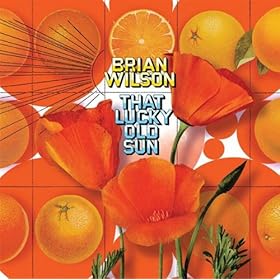
So today, Brian appeared at Newbury Comics in Faneuil Hall to sign autographs at noon, and tonight he performs the album in its entirety (in addition to the usual supercatalog of hits) at the Orpheum Theatre. Faneuil Hall is a lovely tourist spot to walk around on a summer day, but not the easiest place to get to when you're coming from 12 miles north of the city and have to drop your oldest daughter off at school probably an equal distance west of the city. There's no parking and in addition, the temperature was in the 20s with a wind chill that made it feel like 0.
The plan was that Newbury Comics were allowing people to line up as early as 7am, then they would open their doors at 8am so people could come in, buy the new album, and get a wristband for the autograph session. Then we had to wait outside until noon. I knew I'd be lucky to get there much before 9am, so I was stressed and worried that the wristbands would be gone before I arrived. I weighed various options, including parking near my daughter's school and taking a bus, but I'd probably get a ticket; parking in a garage near Faneuil Hall, which would be very expensive; or parking at work (Boston's South End) and hustling to take any combination of bus and train that would get me to Faneul Hall ASAP. I opted for the latter approach. I missed the bus that would take me quickly and warmly to a subway station, so I walked fast and ran, the cold air burning my lungs, got on a train, got off nearby, and ran through traffic to get to Newbury Comics. I did, in fact, arrive before 9am. But was I lucky?
As it turned out, the weather (or ungenerous employers) kept a lot of Brian fans away in the early morning hours, so I was actually 10th in line. That was wonderful. Waiting in the cold was not. Fortunately, however, the Newbury Comics staff were very kind and they worked out a way that most of us could wait inside if we kept to certain places along the walls that didn't obstruct fire exits or other businesses. We passed the time talking about our lives with Brian.
There was a time, early in Brian's reemergence a remarkable 20 years ago now, when I would hold my breath whenever he appeared on TV, at a book signing, or in concert. I feared he would fail somehow, that the pressure or the unpredictability would set him off or shut him down. But he has always been a remarkably strong and committed trouper. I've seen him blow lines but he went on like the seasoned pro that he is. At this point, I'm sure he's done more live shows as a solo artist than he did with the Beach Boys. It's OK now. If I'm breathless at a Brian Wilson show now, it's because of the music, not because of my paternal concern for his well-being.
Brian was in a wonderful mood this morning. He smiled, said hi to people, even sang along a little to the new album, which was playing in the store. There were fairly strict rules about what he would sign and what we could and couldn't do (we could take photos in line but not stand next to him or touch him), and as soon as our stuff was signed we were whisked back out to the freezing street. But before I took my freshly autographed items off the table, I said, "Thank you, Brian. Your music really means a lot to me."
And really, what was cool about this morning, this day of meeting Brian ever so briefly, was not what I got but what I felt. Gratitude. And for the first time in a long time, the sense that I was lucky.

No. It's a children's song. The way forward will come from innocence, simplicity, and youthful optimism. That was Brian Wilson's way forward, too.
Surf's Up
Brian Wilson/Van Dyke Parks
A diamond necklace played the pawn
Hand in hand some drummed along
To a handsome mannered baton
A blind class aristocracy
Back through the opera glass you see
The pit and the pendulum drawn
Columnated ruins domino
Canvass the town and brush the backdrop
Are you sleeping?
Hung velvet overtaken me
Dim chandelier awaken me
To a song dissolved in the dawn
The music hall a costly bow
The music all is lost for now
To a muted trumpeter swan
Columnated ruins domino
Canvass the town and brush the backdrop
Are you sleeping, Brother John?
Dove nested towers the hour was
Strike the street quicksilver moon
Carriage across the fog
Two-step to lamp lights cellar tune
The laughs come hard in Auld Lang Syne
The glass was raised, the fired-roast
The fullness of the wine, the dim last toasting
While at port adieu or die
A choke of grief heart hardened I
Beyond belief a broken man too tough to cry
Surf's Up
Aboard a tidal wave
Come about hard and join
The young and often spring you gave
I heard the word
Wonderful thing
A children's song
A children's song
Have you listened as they played
Their song is love
And the children know the way
Brian Wilson fell as surely as did any ancient civilization, in a swirl of drugs, mental illness, obesity, and neglect. Yet today he is fit, clean (except for prescribed psychotropics), musically and physically active, and productive, having released his 10th solo album (including one album credited to Brian Wilson & Van Dyke Parks) earlier this year, called That Lucky Old Sun.
So today, Brian appeared at Newbury Comics in Faneuil Hall to sign autographs at noon, and tonight he performs the album in its entirety (in addition to the usual supercatalog of hits) at the Orpheum Theatre. Faneuil Hall is a lovely tourist spot to walk around on a summer day, but not the easiest place to get to when you're coming from 12 miles north of the city and have to drop your oldest daughter off at school probably an equal distance west of the city. There's no parking and in addition, the temperature was in the 20s with a wind chill that made it feel like 0.
The plan was that Newbury Comics were allowing people to line up as early as 7am, then they would open their doors at 8am so people could come in, buy the new album, and get a wristband for the autograph session. Then we had to wait outside until noon. I knew I'd be lucky to get there much before 9am, so I was stressed and worried that the wristbands would be gone before I arrived. I weighed various options, including parking near my daughter's school and taking a bus, but I'd probably get a ticket; parking in a garage near Faneuil Hall, which would be very expensive; or parking at work (Boston's South End) and hustling to take any combination of bus and train that would get me to Faneul Hall ASAP. I opted for the latter approach. I missed the bus that would take me quickly and warmly to a subway station, so I walked fast and ran, the cold air burning my lungs, got on a train, got off nearby, and ran through traffic to get to Newbury Comics. I did, in fact, arrive before 9am. But was I lucky?
As it turned out, the weather (or ungenerous employers) kept a lot of Brian fans away in the early morning hours, so I was actually 10th in line. That was wonderful. Waiting in the cold was not. Fortunately, however, the Newbury Comics staff were very kind and they worked out a way that most of us could wait inside if we kept to certain places along the walls that didn't obstruct fire exits or other businesses. We passed the time talking about our lives with Brian.
There was a time, early in Brian's reemergence a remarkable 20 years ago now, when I would hold my breath whenever he appeared on TV, at a book signing, or in concert. I feared he would fail somehow, that the pressure or the unpredictability would set him off or shut him down. But he has always been a remarkably strong and committed trouper. I've seen him blow lines but he went on like the seasoned pro that he is. At this point, I'm sure he's done more live shows as a solo artist than he did with the Beach Boys. It's OK now. If I'm breathless at a Brian Wilson show now, it's because of the music, not because of my paternal concern for his well-being.
Brian was in a wonderful mood this morning. He smiled, said hi to people, even sang along a little to the new album, which was playing in the store. There were fairly strict rules about what he would sign and what we could and couldn't do (we could take photos in line but not stand next to him or touch him), and as soon as our stuff was signed we were whisked back out to the freezing street. But before I took my freshly autographed items off the table, I said, "Thank you, Brian. Your music really means a lot to me."
And really, what was cool about this morning, this day of meeting Brian ever so briefly, was not what I got but what I felt. Gratitude. And for the first time in a long time, the sense that I was lucky.

Thursday, November 13, 2008
Current Projects VI: Turkish novel
Cutting in line is one of the great joys in life, a small act of civil disobedience often made possible by having an ally near the front. Similarly, vaulting over a queue of planned projects is easy when the queue-maker is particularly excited about the latest project to pop into his mind. In this case, it's a novel based on my real-life experience in befriending a Turkish family, and the sometimes bumpy road to understanding and affection we traveled together.
It started about four years ago. My oldest daughter was entering second grade, and my wife had just started a family mentoring initiative in which an experienced school family would take a new school family under their wing and help guide them through the transition and answer their questions. She made the matches without much difficulty until she came upon a new family that had just arrived from Turkey. Mom and Dad spoke very little English, their daughter (same age and grade as mine) none at all. Our Mayberry-esque little suburban school system was ill-equipped to serve them and my wife couldn't see saddling another family with such a challenge, so naturally, social worker that she is, she decided we would be their mentors.
during the first couple of weeks, my wife tried unsuccessfully to convince the school to allow an interpreter to be in the girl's classroom. Hiding behind the banner of Immersion, the principal and teacher were in fact too cheap, shortsighted, and possibly even racist to make such a small yet significant accommodation. No matter, within a few months the girl was reading English texts at same high level as my daughter.
The first month or so of school, I had yet to meet the Turks, as I was working. But Laura wanted me to meet them, so she arranged for them to come to our house one Saturday. Even on a level linguistic playing field, I am no great conversationalist, so it was definitely uncomfortable at first. But they seemed friendly and likable. The parents, Kerem and Olgun, were young and very attractive. He was a customs official in Turkey, she had been a district attorney. The Turkish government, we learned, was interested in sending government workers to the US to study international finance at Boston University. For some reason, they had been advised to look in our sleepy bedroom community of Melrose to live during the two-year program. One would think the more diverse Boston/Cambridge student meccas would have been a more appropriate location. But they were here and our mission was to make them feel welcome.
Our daughter, Hannah, and theirs, Ilayda, played silently yet cooperatively together apart from us. After a bit, Kerem started peppering me with difficult questions, based on things he'd heard were true about Americans and Jews. What was the connection between freemasonry and Judaism? Was it true that Jews who worked in the World Trade Center stayed home on 9/11? Why do Americans allow President Bush to burn up the middle east? Rather than challenging me or my values, he was asking out of pure curiosity. He'd heard these things and wanted to know my response. As clearly, simply, yet as definitively as I could, I rebutted these rumors. I didn't know the connection between masons and Jews (though my father is a Shriner, I'm not privy to the secrets since I have never elected to join) other than it seems to go back to King Solomon and the building of the temple, yet there is nothing sinister about either group. Jews did not stay home on 9/11 and a simple reading of the list of victims shows that a great many Jews were among the dead. Many Americans protest their government but in a democracy we work within the system rather than stage coups.
He seemed satisfied with my responses, though he often continued to challenge me about American foreign policy. In fact, as liberals, my wife and I were very ashamed at what we were doing in the world and the incompetency of the Bush administration, and we told him we could not and would not defend Bush. In a way, this formed a bond between us, but a number of other families in Melrose were suspicious of them because they were not as willing to criticize their own government - at least not to a Muslim family.
And yes, of course, they were Muslims and we were Jews. We actually knew far better than they did that the two religions are very similar. The first time Kerem heard us say Shalom Aleichem, he was stunned because the Muslim phrase for "peace be to you" is pronounced almost identically. The dietary laws behind Kosher and Halal are virtually the same. And the stories of Abraham, Isaac, and Ishmael are foundational to both religions, although they differ in that to Jews, Isaac was the favored son and to Muslims, it is Ishmael.
Our friends were Muslims but they were not strict Muslims. They did not pray regularly, and they drank alcohol. And this was one of the great gifts for us, as Kerem introduced me to raki (rahk-UH), an anise-flavored liquor known as Lion's Milk because it turns white when you add water to it and has a bite like a lion. He was most impressed the first time we drank together because I was able to walk away afterwards, though I was in no shape to drive. I was impressed by the ceremony around it. One prepares mezes, small bites of food like tapas, and eats while drinking. One also engages in pleasant conversation while drinking. One drinks leisurely and comfortably and toasts often ("Serefe!"). It is polite when clinking glasses to have the rim of your glass hit below the rim of the other person's, thus humbling yourself to your guest. It is delicious and delivers a nice, clean buzz.
Their food was wonderful, too. Olgun was an amazing cook, and while Hannah and Ilayda became very close friends, Hannah never took to the food. On the other hand, Ilayda took very easily to American junk food.
After two years, they moved back to Turkey. In the interim, they had a baby and so did we. In fact, they delayed their departure a few weeks because they wanted to be here when our baby was born. They have told succeeding families to come to Melrose and call us for help. The small apartment building in which they lived in time became 100% occupied by Turkish nationals studying at BU. We met some of the them, not all, but never established the kind of friendship that continues to this day. We hope someday soon to visit them in Turkey, and then to travel to Israel. We still keep in touch via email, and they recently sent us a CD of lovely Turkish music.
In retrospect, meeting this Turkish family was one of the great occurrences of my life. I learned so much from them and was able to teach them as well. In all the time we've known each other, there are only two things I can't shake them of: They reject the veracity of the Armenian genocide, and they believe George W. Bush was complicit in 9/11. We have agreed to disagree, yet this will be a key aspect to the novel. Partly because it is so rich, and such a unique experience, and because I love them so much, I am starting this novel today.

Wednesday, November 5, 2008
The Requisite Obama Post
Wow. I'm still stunned. Sometimes you want something so bad, all you can think about is how crushed you'll be if you don't get it. And then you worry about spooking the karma gods, and you begin to think that the more you want something, the less likely it is that you'll get it. So it was that I was momentarily crestfallen when the very first returns came in and McCain had 7 or 8 electoral votes to Obama's 3. It wasn't too long before it became clear that if Obama could cherrypick a couple of those pesky middle of the country states, it would be clear sailing to the west coast and a certain victory. With Pennsylvania and Ohio in the bag, it truly was just a matter of time before California's 55 votes gave the Big O the Big V.
I figured I'd have to write about this, and yet I was emotionally drained from the whole campaign, and didn't know what to say. It's hard to write to a computer screen, especially when the computer screen doesn't often write back. But a dear friend can get you to talking, and that's what happened this evening. One of my bestest, closest, dearestest friends, Eric in San Francisco, wrote me a note and his thoughts inspired me to write a little something of my own back to him. Here's an excerpt of our email conversation.
Eric:
I am sure you were able to appreciate the gravity of the moment and the incredible well-spring of hope that erupted. The faces of young people excited to be taking part, the faces of older black people crying as an event occurred that they never would have imagined possible.
And the man himself - sober and clear in victory - more somber than celebratory, reaching on both sides of the aisle - the hope of forging a new American identity. None of this would occurred with the McCain and Palin team - instead it would meant 4 more years of divisive ugliness.
Looking at the 250,000 people who assembled in Grant park and comparing them with the 2,000 who came together in Arizona - it was a striking snapshot of who the 2 parties represent and the future (I hope) of our country.
By 2050 - and maybe sooner - white people will be a minority here, the minorities together will be the majority. This could be the beginning of an exciting identity shift for our country at home and around the world.
With love,
Eric
My response:
Brother, this was sweet and I've been very emotional over it all. Not only did I cry in the moment, but at several times this morning hearing clips from the moment and from people who have waited their lifetimes and the lifetimes of several generations before for a moment when they could look at the highest peak of American achievement and see themselves represented. I got chills listening to Rep. John Lewis on ABC and CBS last night (I was less moved by Jesse's tears, as he was a bit of a dick to Obama during the campaign). I think there are three mountaintop events/eras in black American history: Emancipation/13th Amendment; March on Washington/Civil Rights Act; and last night. Jackie Robinson would be a 4th, but somehow less monumental than the others.
It's rare when you get to see history made - and really positive, meaningful history. 9/11 was history but that was a drag. The Patriots winning three Super Bowls in four years was history but that don't mean shit. This was a moment for standing tall, for realizing that as flawed as humanity is, it's the only construct in the universe that knows the concept of hope, that can generate it and be inspired by it, that when things are low they are merely at the ebb of a continuing cycle, and that it's the efforts of a committed and united humanity that can bring it high again. It's a beautiful thing, and I feel blessed to be living through it, and grateful that my children can see it and live in this world where anything is possible. And it's a good feeling when life is hard personally to know that each day is a new opportunity to make it a little better.
Peace, my brother. We have overcome the Bush years. We finally have a president elected not because of the color of his skin, but because of the content of his character.
Much love,
Jason
Tuesday, October 21, 2008
"Honor among rogues"?
“To say that a man is your friend, means commonly no more than this, that he is not your enemy. Most contemplate only what would be the accidental and trifling advantages of friendship, as that the friend can assist in time of need, by his substance, or his influence, or his counsel; but he who foresees such advantages in this relation proves himself blind to its real advantage, or indeed wholly inexperienced in the relation itself…. What is commonly called Friendship is only a little more honor among rogues. But sometimes we are said to love another, that is, to stand in a true relation to him, so that we give the best to, and receive the best from, him. Between whom there is hearty truth there is love; and in proportion to our truthfulness and confidence in one another our lives are divine and miraculous, and answer to our ideal. There are passages of affection in our intercourse with mortal men and women, such as no prophecy had taught us to expect, which transcend our earthly life, and anticipate heaven for us.”
- Henry David Thoreau, On the Concord River
I long have been fascinated by friendship. The concept, that is. What makes for friendship between two people, why some friendships sour and why others endure. My curiosity stems from my personal experience. At various times in the course of one's youth, alliances are formed and shifted. Bonds are forged, hurts are felt, and it all seems like a blur of speed dating or an awkward square dance until the music stops, you are 45 years old, and you wonder where your old friends went and where your new friends came from.
When I was an adolescent, I was one of a core group of four friends, memorialized in my one-act play of the same name. We had other friends as well, but we four I guess you could say had more intense adventures together, we took ourselves further to the boundaries of experience. Among other friends, it was a laugh, when the four of us were together, we were serious about what we were doing, whether it was listening to music, trespassing on a golf course at night with a case of beer and other substances, talking into the wee hours, or dreaming about forming a band. We seemed a very tight-knit group.
Yet whenever there was some kind of an issue about which there was no unanimity, our quartet would split into two dyads. And always the same two. Later, awkwardly, two of us, one from each dyad, had a major falling out, and then it became two separate trios. Actually, three, since one of us was a year older and went away to college before us. The next year, two more of us went away to college, one never did. The three in college went to the same college, but wouldn't you know only two of us, from an older dyad, stayed close. After college, nothing was quite the same. The one who stayed home found a new group of friends and the rest of us never really gelled with them.
Within a few years, we were completely splintered and then one of us died. Two who had been estranged became reacquainted. But the remaining three seem to have little left in common. We are friendly, but can we be said to be friends?
The unraveling of this group has intrigued me for a long time. I dare say it has troubled me. We seemed to have so much in common once. Had we all changed so much? Were the bonds we had shared in the past no longer valid? Had they ever been?
Aside from my play, I have tried writing about friendship over time in other stories. Until I figure it out, I'm not sure I can complete any of them. My current hypothesis is that what poses as commonality is really largely just proximity. I was friends with my friends because they were geographically close to me. We all lived just a few blocks from each other; I and my dyad-mate, in fact, were next door neighbors. We had other similarities, of course, some of them quasi-cosmic: three of us were Aquarians, the other a Pisces; the three Aquarians all had the same middle name, Mark, and the Piscean's first name was Marc. We were all Jewish, we went to the same school, and we all basically liked the same music. Personality-wise, we were far from identical, but it didn't seem to matter then.
Now it seems to matter a great deal. I won't describe us because it will only sound as though I was normal and the rest less than. Suffice to say, I don't always find their personalities so ignorable anymore. Why is that so? Again, I think part of has to do with proximity, or lack of it. We all went in separate directions professionally, we all live in different areas. I am more religious than the others and so am more connected to Jewish ritual and community. My musical tastes are broad and challenging. I am a writer, hopelessly nostalgic, yearning and dreaming of realizing my creative vision.
Of the other two, one is a Deadhead/Phishhead type who owns a small service business, and the other is a wealthy attorney. We three are very much like the archetypes outlined in a concept album by my favorite progressive rock group, Gentle Giant, in their 1972 album, Three Friends. In that album, three friends who are very close in school drift apart as they enter the working world. One is working class ("Working All Day"), one is an artist ("Peel the Paint"), one is rich ("Mister Class and Quality?").

By being part of different worlds, different communities, we have each been broadened in different ways. Further, we are all part of multiple worlds, multiple communities. We have our home domain, our work domain, as well as cultural and avocational domains. Because we lack proximity to each other, we can't stoke the core elements that once drew us together, and they become further suffused by the layers of new contacts, qualities, skills, interests, and friends that we accumulate every day. When we get together, we almost don't know each other anymore. We default to the shorthand and inside jokes that were relevant 25, 30 years ago, but those things aren't how we define ourselves today and we find it difficult to get reacquainted to who we all are now.
Maybe if we spent a week in a cabin in the woods, we would learn better who we are now. Maybe we would find even more conclusively that we are not simpatico anymore. Maybe it's better simply to sustain the tenuous thread that keeps us connected, and try neither to strengthen it nor take scissors to it. After all, it's not wrong that we grew, that we changed. Nor is it wrong that we grew and changed in different ways. Proximity served its purpose then; the lack of it also serves a purpose today. It allows us to evolve without the constraining expectations of childhood alliances.
Interestingly, I find that I have more interesting interactions with my second tier of friends, those outside the four with whom we were always friendly yet in a more general social way. I had lost touch with them as well, yet I find today that not only do we still retain meaningful bonds and values from the old days, but we are also able to successfully integrate the lives and qualities we possess now. I'm not sure why that it. Maybe my quartet was too intense, maybe we applied too much pressure to maintaining the integrity of our small group, maybe we inadvertently kept each other from doing the self-exploration that is so necessary in adolescence and early adulthood.
I look at my current friends and I don't have one with whom I share the kind of closeness I knew as a child, when two people seem to be one. I have music friends, sports friends, Jewish friends, work friends, neighborhood friends, 117 Facebook friends (several of whom I barely know)...I don't have anyone who spans the entirety of my experience. Maybe I never did. Maybe that's why I feel a certain void in my life that keeps me looking back, trying to reclaim something I thought existed.
Maybe it's not a friendship I lost that intrigues me, maybe it's a friendship I never had. If indeed it has eluded me all these years, why do I feel I need it now? And would I know if it were to come to me? And if I did, would it fulfill me?
- Henry David Thoreau, On the Concord River
I long have been fascinated by friendship. The concept, that is. What makes for friendship between two people, why some friendships sour and why others endure. My curiosity stems from my personal experience. At various times in the course of one's youth, alliances are formed and shifted. Bonds are forged, hurts are felt, and it all seems like a blur of speed dating or an awkward square dance until the music stops, you are 45 years old, and you wonder where your old friends went and where your new friends came from.
When I was an adolescent, I was one of a core group of four friends, memorialized in my one-act play of the same name. We had other friends as well, but we four I guess you could say had more intense adventures together, we took ourselves further to the boundaries of experience. Among other friends, it was a laugh, when the four of us were together, we were serious about what we were doing, whether it was listening to music, trespassing on a golf course at night with a case of beer and other substances, talking into the wee hours, or dreaming about forming a band. We seemed a very tight-knit group.
Yet whenever there was some kind of an issue about which there was no unanimity, our quartet would split into two dyads. And always the same two. Later, awkwardly, two of us, one from each dyad, had a major falling out, and then it became two separate trios. Actually, three, since one of us was a year older and went away to college before us. The next year, two more of us went away to college, one never did. The three in college went to the same college, but wouldn't you know only two of us, from an older dyad, stayed close. After college, nothing was quite the same. The one who stayed home found a new group of friends and the rest of us never really gelled with them.
Within a few years, we were completely splintered and then one of us died. Two who had been estranged became reacquainted. But the remaining three seem to have little left in common. We are friendly, but can we be said to be friends?
The unraveling of this group has intrigued me for a long time. I dare say it has troubled me. We seemed to have so much in common once. Had we all changed so much? Were the bonds we had shared in the past no longer valid? Had they ever been?
Aside from my play, I have tried writing about friendship over time in other stories. Until I figure it out, I'm not sure I can complete any of them. My current hypothesis is that what poses as commonality is really largely just proximity. I was friends with my friends because they were geographically close to me. We all lived just a few blocks from each other; I and my dyad-mate, in fact, were next door neighbors. We had other similarities, of course, some of them quasi-cosmic: three of us were Aquarians, the other a Pisces; the three Aquarians all had the same middle name, Mark, and the Piscean's first name was Marc. We were all Jewish, we went to the same school, and we all basically liked the same music. Personality-wise, we were far from identical, but it didn't seem to matter then.
Now it seems to matter a great deal. I won't describe us because it will only sound as though I was normal and the rest less than. Suffice to say, I don't always find their personalities so ignorable anymore. Why is that so? Again, I think part of has to do with proximity, or lack of it. We all went in separate directions professionally, we all live in different areas. I am more religious than the others and so am more connected to Jewish ritual and community. My musical tastes are broad and challenging. I am a writer, hopelessly nostalgic, yearning and dreaming of realizing my creative vision.
Of the other two, one is a Deadhead/Phishhead type who owns a small service business, and the other is a wealthy attorney. We three are very much like the archetypes outlined in a concept album by my favorite progressive rock group, Gentle Giant, in their 1972 album, Three Friends. In that album, three friends who are very close in school drift apart as they enter the working world. One is working class ("Working All Day"), one is an artist ("Peel the Paint"), one is rich ("Mister Class and Quality?").
By being part of different worlds, different communities, we have each been broadened in different ways. Further, we are all part of multiple worlds, multiple communities. We have our home domain, our work domain, as well as cultural and avocational domains. Because we lack proximity to each other, we can't stoke the core elements that once drew us together, and they become further suffused by the layers of new contacts, qualities, skills, interests, and friends that we accumulate every day. When we get together, we almost don't know each other anymore. We default to the shorthand and inside jokes that were relevant 25, 30 years ago, but those things aren't how we define ourselves today and we find it difficult to get reacquainted to who we all are now.
Maybe if we spent a week in a cabin in the woods, we would learn better who we are now. Maybe we would find even more conclusively that we are not simpatico anymore. Maybe it's better simply to sustain the tenuous thread that keeps us connected, and try neither to strengthen it nor take scissors to it. After all, it's not wrong that we grew, that we changed. Nor is it wrong that we grew and changed in different ways. Proximity served its purpose then; the lack of it also serves a purpose today. It allows us to evolve without the constraining expectations of childhood alliances.
Interestingly, I find that I have more interesting interactions with my second tier of friends, those outside the four with whom we were always friendly yet in a more general social way. I had lost touch with them as well, yet I find today that not only do we still retain meaningful bonds and values from the old days, but we are also able to successfully integrate the lives and qualities we possess now. I'm not sure why that it. Maybe my quartet was too intense, maybe we applied too much pressure to maintaining the integrity of our small group, maybe we inadvertently kept each other from doing the self-exploration that is so necessary in adolescence and early adulthood.
I look at my current friends and I don't have one with whom I share the kind of closeness I knew as a child, when two people seem to be one. I have music friends, sports friends, Jewish friends, work friends, neighborhood friends, 117 Facebook friends (several of whom I barely know)...I don't have anyone who spans the entirety of my experience. Maybe I never did. Maybe that's why I feel a certain void in my life that keeps me looking back, trying to reclaim something I thought existed.
Maybe it's not a friendship I lost that intrigues me, maybe it's a friendship I never had. If indeed it has eluded me all these years, why do I feel I need it now? And would I know if it were to come to me? And if I did, would it fulfill me?
Sunday, October 12, 2008
If a post enters the blogosphere and no one comments on it, does it have any impact?
Heavy question for a long holiday weekend. But it's been on my mind, since I'm still relatively new to the blogging thing and I guess maybe I still need to be convinced that there's a point to it beyond being a purely egocentric forum for whatever it is about me that I want to broadcast to the anonymous masses who come here - mostly quite accidentally - and scan the offerings.
The days when I check my blog and see a comment are extremely gratifying - and rare. I've enjoyed learning how people found my blog and what of value they found in whatever post it was that they commented on. It's endlessly fascinating how connections work in this (n)etherland. I've "met" people who share my interest in family history, who have a loved one afflicted with the same disease that claimed my mother, and who want me to pursue one of my future projects. It is in these moments that Tim Berners-Lee's vision of the World Wide Web becomes real to me - that there is something in these links and pages of user-generated content that can not only connect but potentially heal humanity.
What I wonder about it why so many people from so many countries (at least a dozen, according to my site counter) come here, look around briefly, and leave without making their mark. Maybe they took a quick scan and didn't find anything worthwhile here. I can understand that. Different strokes for different folks. I can't get too upset if someone I don't know doesn't take interest in my personal life and work. But I sense that people (other than a certain colleague who lets me know in personal, analog terms that she has read and enjoyed my posts) are actually reading the content and then clicking away for someone else's two cents. To them I say, "Hey, at least leave a calling card so I can thank you for the visit."
For a writer, particularly, feedback is a critical part of the creative process. Yes, there's a certain sense of "I need to put this on paper regardless if anyone reads it" but the obverse of this is "If no one reads what I write, why then am I writing?" A song never heard by an audience may have an intrinsic value, but the lack of extrinsic interest and acceptance renders it largely moot. It calls to mind the famous quote by Hillel: "If I am not for myself, who will be for me? And when I am for myself, what am 'I'? And if not now, when?" To put it another way, if I choose to write that others may learn from and/or enjoy my writing, is there an audience willing to consume it? And should I choose to write to feed my soul rather than my family, how does that change my sense of role, of identity, both in and of myself and in the eyes of others?
And if not know, when? Well, therein lies the rub and the root of my inquiry. If you read something here and do not comment on it immediately, will you ever? And if the time to do so it now, will you do so? If not, why not? I am putting myself out here for your consumption. Will you not do the same? Is it coincidence that most of the comments I have received are from other bloggers? Who knows what lurks in the hearts of lurkers? If they don't comment, we'll never know.
Friday, October 10, 2008
Close but no cigar
On July 8, 2008, I posted a piece called "In the presence of genius," in which I spoke about some of the brilliant people I have had the opportunity to meet and interview in my job. Two of the folks were from MIT: Tim Berners-Lee, the inventor of the World Wide Web; and Robert Langer, a chemical engineer who has developed remarkable nanotechnologies for biomedical applications.
Recently, I was asked to edit an article about the fact that of the three winners to date of Finland's Millennium Technology Prize - a prestigious global award with a purse of $1.4 million for people who develop innovative technologies that aid humanity - two have been MIT engineers. Yes, you guessed it: Berners-Lee and Langer. Anyway, the first draft of the article needed a lot of work so I rewrote it, to the client's delight.
Then last week, our client came to our office to tell us that there was a chance the article may have to be rewritten again. It appears that both Berners-Lee and Langer were finalists for Nobel prizes, announced this past week. Langer was up for the Nobel for Medicine, Berners-Lee for the Peace Prize. As it turns out, neither got the nod, and my own opportunity for further bragging rights also evaporated.
Had Langer won, he would have become the first engineer to win the award for Medicine. It would seem that his time is coming, however, as the Nobel is pretty much the only major award he hasn't received yet. The man is a true superstar in his field, and royalty at MIT, where his last name is uttered in reverent tones.
As for Berners-Lee, the very notion that a technologist who invented a computing concept and a programming language could be considered for the Nobel Peace Prize is indicative of just how monumental the World Wide Web is. The Nobel committee may never come to terms with giving an engineer a Peace Prize, but what would the world be like today minus his fingerprints?
Anyway, the article doesn't need to be rewritten now.
Subscribe to:
Posts (Atom)